Physical Address
304 North Cardinal St.
Dorchester Center, MA 02124
Physical Address
304 North Cardinal St.
Dorchester Center, MA 02124

Qin Dynasty (221–207 BC) was the first unified feudal empire in Chinese history, founded by Emperor Qin Shi Huang, Ying Zheng. Although the dynasty lasted only fifteen years, it ended the long period of war during the Warring States era, implemented centralization, and laid the political foundation for more than two thousand years of imperial rule in China. The Qin Dynasty’s political, economic, military, and cultural reforms, though accompanied by tyranny and widespread discontent, left an indelible mark on Chinese history.
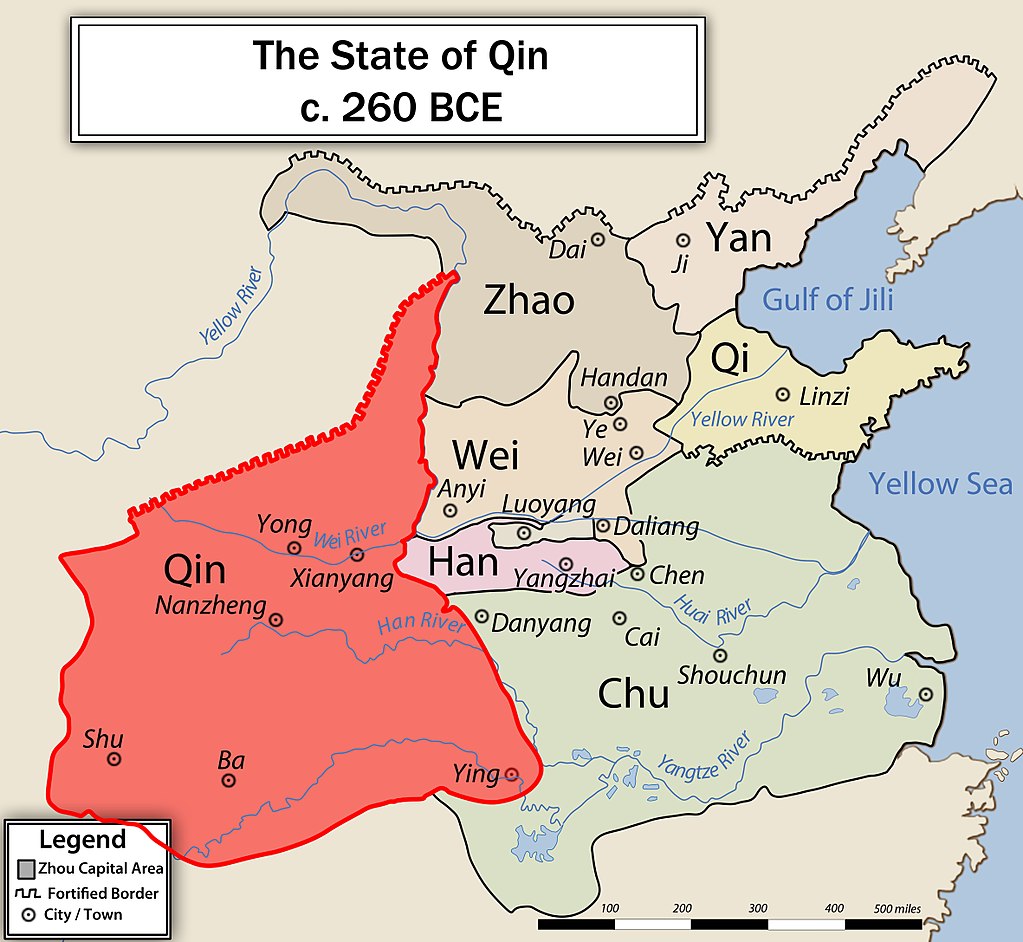
During the Warring States period (475–221 BC), China was divided into seven major states, each competing for dominance. Continuous warfare caused immense suffering, social instability, and economic disruption. The Qin state, located in the western frontier, governed according to Legalist principles, emphasizing strict laws and military strength. Through generations of accumulation, Qin became the strongest state.
In 246 BC, the thirteen-year-old Ying Zheng ascended the throne and inherited a powerful Qin state. With his guidance, Qin launched a series of military campaigns from 230 BC, gradually defeating and annexing the six other states—Han, Zhao, Wei, Yan, Chu, and Qi—thereby achieving national unification.
In 221 BC, Ying Zheng completed the unification of China, declared himself “First Emperor,” established the Qin Dynasty, and set the capital at Xianyang, marking the beginning of a centralized imperial China.
Emperor Qin Shi Huang established a highly centralized political system. He abolished the feudal system and implemented the prefecture-county system. The country was divided into 36 prefectures, each governed by centrally appointed officials directly accountable to the emperor, effectively reducing local powers.
Qin also established the Three Lords and Nine Ministers system to manage the bureaucracy:
Strict laws codified in the Qin Legal Code reinforced imperial authority. Anyone violating the law, regardless of social status, faced severe punishment, ensuring central control and uniform enforcement.
The Qin Dynasty implemented nationwide economic reforms to integrate society and stimulate development.
Infrastructure construction was another focus:
While these reforms strengthened the economy and unified the empire, heavy labor and taxation caused widespread suffering.
Heavy taxes and forced labor placed enormous pressure on the population. Northern peasants were conscripted to build the Great Wall and roads, enduring harsh winters and hot summers, with many dying from exhaustion. Southern farmers were forced to construct palaces and waterworks, plunging families into poverty. Historical records tell of a farmer surnamed Li, conscripted to build the Xianyang palace, separated from his family for years, and dying on the worksite, leaving his family destitute. Such stories illustrate the hardships ordinary people faced and growing resentment toward the emperor.
Qin’s military system required all adult men to serve in the army. The state maintained a massive standing army, well-trained and disciplined, making Qin one of the most powerful militaries of its time.
The Battle of Changping exemplifies Qin military strategy. By surrounding Zhao forces and cutting off supplies, tens of thousands of Zhao soldiers perished or were executed. The battle demonstrated both Qin’s military effectiveness and its ruthlessness.
Qin stationed heavy troops along the northern borders, establishing agricultural colonies (tuntian) to support frontier forces. The Terracotta Army buried with Qin Shi Huang reflected highly organized troop structures, weaponry, and hierarchical military divisions.
After unification, Qin Shi Huang conducted multiple tours across the empire to consolidate power and inspect administration. Historical records mention six major tours:
During these tours, Qin traveled in luxurious processions with thousands of attendants and guards. He ordered temporary palaces, bridges, and roads along the route, demonstrating imperial power. However, the construction often demanded enormous labor from peasants, generating resentment.
Qin Shi Huang enforced cultural unification while strictly controlling thought. He ordered the burning of books and burying of scholars, prohibiting private possession of Confucian classics and historical texts to prevent challenges to imperial authority. In 213 BC, all non-technical books were burned, and in 212 BC, 460 scholars were executed for dissent.
Despite ideological suppression, the dynasty achieved cultural and artistic accomplishments:
After Qin Shi Huang’s death, his son Hu Hai ascended the throne. Incompetent and easily manipulated by the eunuch Zhao Gao, his rule weakened central authority. In 209 BC, peasant uprisings led by Chen Sheng and Wu Guang spread rapidly, sparking large-scale rebellion.
By 207 BC, Qin forces were defeated by Xiang Yu and Liu Bang, and the capital Xianyang fell. The dynasty’s collapse led to the Chu-Han Contention, ending with Liu Bang’s victory and the establishment of the Western Han Dynasty, which retained the centralization framework established by Qin.
Although brief, the Qin Dynasty had profound historical impact:
